 SEO Fundamentals
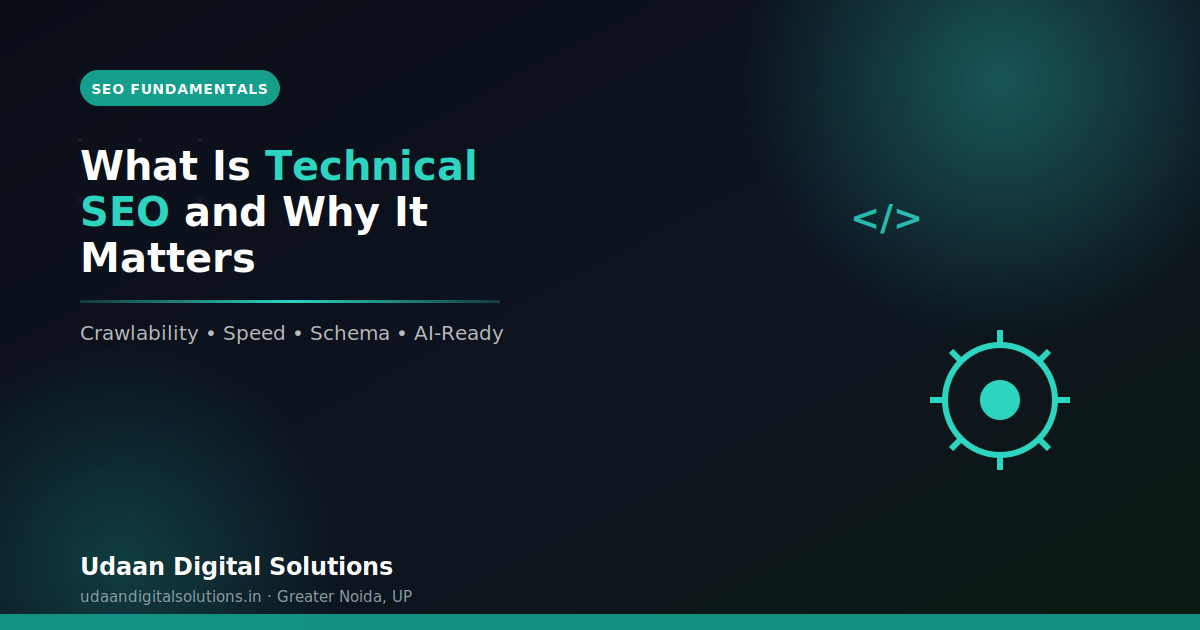
What Is Technical SEO and Why It Matters (2026 Guide)
Most website owners think about SEO in terms of content and keywords, and never look at what’s actually happening under the hood. That’s a mistake — a technically broken site can publish excellent content for years and still stay invisible. This guide explains what technical SEO actually covers, why it’s become more demanding in 2026, and what a properly built site does differently.
Table of Contents
- What Is Technical SEO and Why It Matters — The Core Definition
- The Core Pillars of Technical SEO
- Why Technical SEO Matters Even More in 2026
- Technical SEO vs On-Page vs Off-Page SEO
- A Common Situation: Great Content, Technically Invisible
- Which Technical Priorities Fit Your Site’s Stage?
- How Udaan Approaches Technical SEO
- How to Get Started
- A Quick Technical SEO Self-Check
- Common Mistakes That Undermine Technical SEO
- Frequently Asked Questions
- Related Reading
- Final Verdict
1. What Is Technical SEO and Why It Matters — The Core Definition
Technical SEO refers to all the behind-the-scenes optimizations that help search engines discover, crawl, render, and index your website efficiently. It’s the scaffolding underneath everything else — your content strategy, your link building, your on-page work — because none of that matters if a search engine can’t properly access or understand the page in the first place. If your site has crawl errors, duplicate content, or sluggish load times, search engines may never fully index your pages, and no amount of keyword targeting fixes that.
2. The Core Pillars of Technical SEO
| Pillar | What It Covers |
|---|---|
| Crawlability & indexing | Robots.txt, XML sitemaps, and making sure bots can actually reach important pages |
| Core Web Vitals | Load speed (LCP), visual stability (CLS), and interaction readiness (INP) |
| Mobile usability & security | Responsive design and a secure HTTPS connection — both baseline ranking factors |
| Structured data (schema) | Article, LocalBusiness, Product, FAQ, and HowTo markup that tells machines exactly what content is |
| AI-crawler readiness | Content formatted so it can be accurately retrieved and cited by AI answer engines |
3. Why Technical SEO Matters Even More in 2026
You’re no longer optimizing for Google’s crawler alone. AI-powered answer engines — Google AI Overviews, ChatGPT Search, Perplexity — now crawl and interpret websites too, and they rely on the same structural signals: clean crawlability, accurate schema, and content they can confidently attribute back to your site. If your technical foundation has gaps, you become invisible in two ecosystems instead of one. Schema markup in particular has shifted from a nice-to-have to genuine infrastructure — it’s how machines confirm what a page actually is, not just what it says.
4. Technical SEO vs On-Page vs Off-Page SEO
These three work together, not in competition. On-page SEO focuses on individual page content — keywords, headings, and readability, which we covered in our on-page vs off-page SEO breakdown. Technical SEO focuses on site-wide infrastructure instead — crawlability, speed, security, and structured data. A technically flawless site with weak content won’t rank well, and excellent content on a technically broken site often won’t rank at all; both need to be right at the same time.
5. A Common Situation: Great Content, Technically Invisible
A pattern we see often: a business invests heavily in well-written content and consistent publishing, but traffic stays flat for months. A technical audit usually reveals the real cause — a robots.txt file accidentally blocking key sections, a bloated sitemap full of low-value URLs diluting crawl priority, or Core Web Vitals scores in the red from unoptimized images. After fixing these foundational issues, businesses in this position typically see the same content that was already published finally start gaining the visibility it should have had all along. (Illustrative pattern based on typical outcomes for comparable situations; actual results vary by starting point and competition.)
6. Which Technical Priorities Fit Your Site’s Stage?
| Your Situation | What to Prioritize First |
|---|---|
| New website, nothing indexed yet | Crawlability and indexing — sitemap, robots.txt, and basic accessibility |
| Site is indexed but pages load slowly | Core Web Vitals — image optimization, caching, reducing render-blocking scripts |
| Traffic exists, but rankings are inconsistent | Structured data and schema markup across key page types |
| Established site, planning for the long term | AI-crawler readiness — content formatted for accurate retrieval and citation |
7. How Udaan Approaches Technical SEO
Technical SEO isn’t a separate add-on service at Udaan — it’s baked into every website we build, because website development and SEO sit under the same in-house team. That means crawlability, Core Web Vitals, and schema markup are handled at the architecture stage, not discovered as problems six months after launch by a separate SEO vendor who has no ability to touch the code. Every technical audit checks crawlability, indexing, speed, and mobile experience before we recommend a single fix, and every engagement includes monthly reporting through Google Search Console — real numbers you can verify yourself, not a generic branded PDF. Backed by a 2300+-business track record across manufacturing, e-commerce, hospitality, and professional services, that combination is precisely why technical fixes at Udaan translate into ranking movement instead of getting stuck in a queue between two disconnected teams.
8. How to Get Started
1) Book a free technical SEO audit — no commitment required. 2) We review crawlability, Core Web Vitals, mobile experience, and structured data on your actual site. 3) You get a clear, prioritized list of what’s actually holding your rankings back. 4) Fixes are implemented directly by the same team that can also touch your website’s code, with monthly reporting afterward.
Not sure if your site has a technical SEO problem?
Get a free technical SEO audit — we’ll show you exactly what’s blocking your growth, with numbers you can verify yourself.
Get Free SEO Audit9. A Quick Technical SEO Self-Check
- Check your Core Web Vitals: Test your homepage against Google’s Core Web Vitals guidance — anything in the red needs attention.
- Check if you’re indexed: Search
site:yourdomain.comon Google — if key pages are missing, you likely have a crawlability issue. - Check your robots.txt: Make sure important sections like /blog/ or /products/ aren’t accidentally blocked.
- Check your schema markup: Use Google’s Rich Results Test to confirm your structured data is actually valid.
- Check mobile usability: Review the Mobile Usability report inside Google Search Console.
10. Common Mistakes That Undermine Technical SEO
Treating technical SEO as a one-time fix rather than ongoing maintenance is a common trap — sites grow, plugins get added, and new technical debt accumulates constantly. Ignoring Core Web Vitals because “the site looks fine” is another mistake; visual polish and actual load performance are two completely different things. And skipping schema markup because it’s invisible to visitors overlooks that it’s precisely what search engines and AI systems use to confidently understand and cite your content.
Frequently Asked Questions
What is technical SEO in simple terms?
It’s the behind-the-scenes work that helps search engines and AI systems find, load, and understand your website properly — separate from the actual content on your pages.
Why does technical SEO matter if my content is good?
Because search engines need to be able to crawl, render, and index your pages before content quality even factors in. A technically broken site can stay invisible regardless of how good the content is.
What are Core Web Vitals?
Three specific metrics Google uses to measure page experience: LCP (loading speed), CLS (visual stability), and INP (interaction readiness).
Do I need schema markup on every page?
At minimum, every content page should have Article or BlogPosting markup; product, local business, and FAQ pages benefit from their own specific schema types.
Does technical SEO matter for AI search too, not just Google?
Yes — AI answer engines like ChatGPT Search and Google AI Overviews rely on the same crawlability and structured data signals to retrieve and cite content accurately.
How often should a technical SEO audit be done?
At least once or twice a year for an established site, and immediately after any major redesign, platform migration, or significant content addition.
Does Udaan handle technical SEO as part of website development?
Yes, technical SEO is built into every website from the architecture stage since the same in-house team handles both development and SEO.
How do I get started?
Book a free technical SEO audit through our website or call +91 7042278448.
Related Reading
- Udaan Digital Solutions — Home
- On-Page vs Off-Page SEO — Which Matters More in 2026?
- How to Find the Right Keywords for Your Business
- Why Is My Website Not Ranking on Google?
- How to Choose the Right Digital Marketing Agency
- How Much Does a WordPress Website Cost in India in 2026?
- Best SEO Agency Near Me
- Contact Us
Ready to find out if a technical issue is capping your growth?
Talk to our team — a free audit will tell you exactly what’s working and what isn’t.
Get a Quote — Call +91 7042278448