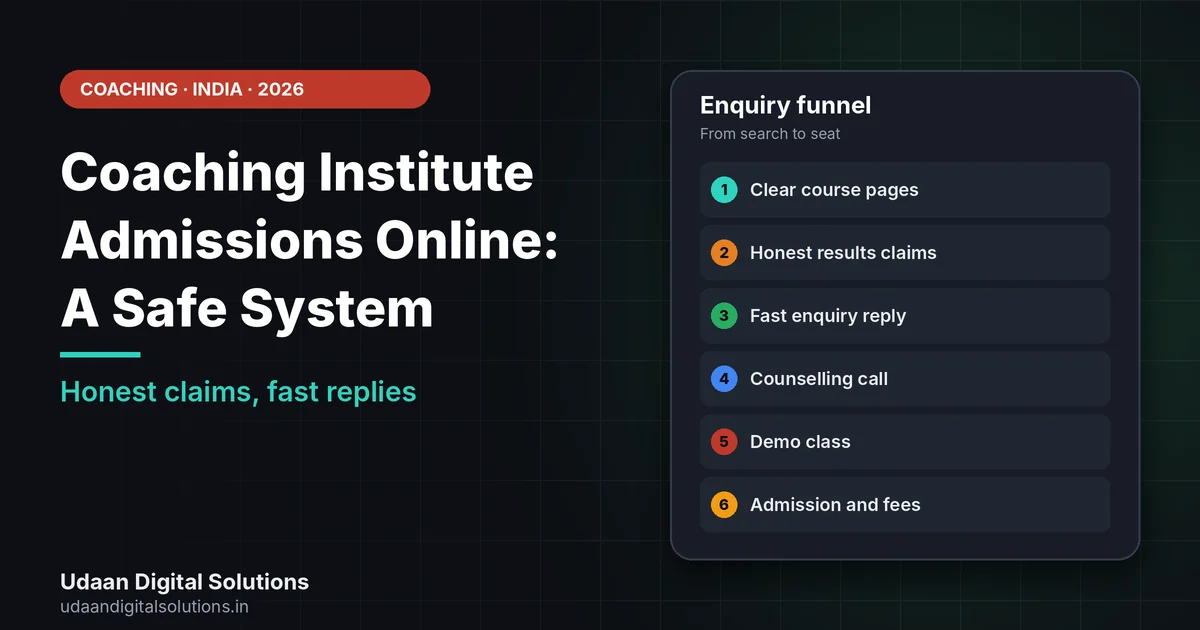
To grow coaching institute admissions online, build a simple enquiry system: clear course pages with fees, an accurate Google listing, a WhatsApp or call button, fast replies, a counselling or demo offer, and tracking through to enrolment. Keep every claim verifiable, because the CCPA’s 2024 guidelines target misleading coaching ads.
Parents compare coaching institutes online before they visit one. The institutes that win admissions are usually clear, quick to reply and honest about results and fees. This guide sets out an enquiry system for coaching institute admissions online, and the advertising rules to check before you publish. For a wider strategy, see our guide to digital marketing for coaching institutes.
Which rules affect coaching institute admissions marketing?
According to MediaNama, the Central Consumer Protection Authority (CCPA) issued the Guidelines for Prevention of Misleading Advertisement in Coaching Sector, 2024. As reported, they cover coaching centres with more than 50 students and anyone endorsing them. They bar exaggerated or unverified claims about success rates, placements and exam scores, misleading descriptions of infrastructure, resources or faculty, and false urgency such as limited seats. Ads must state course duration, faculty qualifications and fees accurately, and disclaimers must be legible. Written consent is needed before using a student’s name, photo or testimonial, and only after the student’s success. Violations are treated as contraventions of the Consumer Protection Act, 2019.
YourStory reported guidelines from the Ministry of Education in January 2024, saying that coaching centres should not enrol students below 16, cannot promise or guarantee a rank or good marks, and should have a website listing tutor qualifications, courses, duration and fees. That report did not say whether states must adopt them, and it noted that regulating this level of education lies with state governments. Treat the central guidelines as the baseline and check your state’s rules.
The lesson for coaching institute admissions marketing is simple: be accurate, be clear about fees, and never promise results.
The coaching institute admissions funnel
Coaching institute admissions do not happen in one click. A family finds you, asks a question, attends counselling or a demo, thinks about it and then enrols. Measure each stage.
| Stage | What happens | What to measure |
|---|---|---|
| Find | Google listing, course pages, YouTube or Instagram | Impressions and clicks |
| Enquire | WhatsApp, call or form | Enquiries and cost per enquiry |
| Counsel | Counselling call or demo class | Counselling attended |
| Decide | Fee details, batch timing, a clear next step | Offers sent and answered |
| Enrol | Simple admission steps and payment | Enrolments and cost per enrolment |

6 steps to more coaching institute admissions online
Write one clear page for each course
For coaching institute admissions, a parent should find class, syllabus, batch timing, duration and fees on one page. For coaching institute admissions, reports of the Ministry of Education guidelines say a centre should list tutor qualifications, courses, duration and fees on its website.
Set up an accurate Google listing
In coaching institute admissions, many families search “coaching near me” or by area. Create or claim your Google Business Profile with the real name, address, phone and timings, and add real photos of classrooms. Do not add keywords to the name.
Give people an easy way to ask
Put a WhatsApp button, a phone number and a short form on every page. Keep forms to name, class, city and phone. Reply fast, because families often message several institutes.
Want a compliant admissions funnel?
Udaan Digital Solutions can build course pages, set up your Google listing and WhatsApp enquiry path, and track enrolments. We do not promise admissions or results.
Talk to Our Team See Pricing →Offer counselling or a demo, not pressure
A short counselling call or demo class moves an enquiry forward without false urgency. Explain the method, the schedule and the support, and let the family decide.
Show results honestly
If you share results, state what they are, the year and the basis, and get written consent before naming or showing a student. Avoid guarantee wording.
Track each enquiry to the end
For coaching institute admissions, record every enquiry and its outcome, then review monthly. Count enrolments by source and stop spending on channels that bring enquiries but no admissions.
What should coaching institutes avoid in online ads?
This table pairs common habits with a safer approach. It is based on news reports of the guidelines, so verify each point in the original text.
| Common habit | Safer approach | Note |
|---|---|---|
| “100% selection” or “guaranteed rank” | State facts you can verify, with year and basis | Unverified success claims are barred, as reported |
| Student photos and toppers without consent | Written consent, only after the student’s success | Consent requirement reported by MediaNama |
| “Only 10 seats left” when untrue | A clear booking call to action | False urgency is listed as barred |
| Hidden or missing fees | Fees and duration shown clearly with legible disclaimers | Accurate fee details are required, as reported |
| Promising a rank or marks to parents | Explain method, schedule and support | Guarantee of rank is not allowed under MoE guidelines, as reported |
| Inflated faculty or facility claims | Real qualifications and real photos | Misleading faculty or infrastructure claims are barred |
Your admissions funnel also depends on a fast, clear website. If visitors arrive but do not enquire, read why a website gets traffic but zero leads. For quick replies, see our guide to a WhatsApp AI sales agent and its risks, and for local listings, our guide to the Google map pack.
What does coaching institute admissions marketing cost at UDS?
The Udaan Digital Solutions pricing page, read on 24 October 2026, listed SEO from ₹7,999 a month, social media from ₹10,000 a month for 8 posts, and ads management from ₹8,000 a month with ad spend separate. GST treatment is not stated. See our digital marketing agency cost guide for what each includes. We do not guarantee admissions.
Coaching institute admissions checklist
Tick each line of this coaching institute admissions checklist before you launch a campaign.
- Course pages: Each course shows duration, timing and fees clearly.
- Listing: Accurate Google profile with real photos.
- Contact: WhatsApp, call and form on every page.
- Claims: Results are verifiable, with year and basis; no guarantees.
- Consent: Written consent for any student’s name, photo or testimonial.
- Urgency: Seat limits are real, or not mentioned.
- Follow-up: Every enquiry gets a reply and a counselling or demo offer.
- Tracking: Enquiries tracked through to enrolment.
If you teach online to students abroad, our sister guide covers online tutoring marketing.
Frequently asked questions: coaching institute admissions
How can a coaching institute get more admissions online?
Make it easy for parents and students to find you and ask a question: an accurate Google listing, a clear page for each course with fees and duration, a WhatsApp or call button, fast replies and a counselling or demo slot. Then track enquiries through to enrolment so you know which channel works.
What does the CCPA say about coaching institute ads?
As reported by MediaNama on 14 November 2024, the guidelines bar exaggerated or unverified claims about success rates, placements and scores, misleading descriptions of facilities and faculty, and false urgency such as limited seats. They require clear fee and duration details and written consent before using a student's name, photo or testimonial.
Can I advertise rank or selection results?
Only with care. Reports of the CCPA and Ministry of Education guidelines say results claims must be accurate and not misleading, and centres cannot promise or guarantee a rank or marks. Show verifiable facts, with consent for any student you name, and check the original guidelines or a lawyer.
Is it okay to say 'limited seats' in an ad?
Be careful. The CCPA guidelines, as reported, list false urgency, such as claiming limited seats or implying high demand, among the barred practices. Only state a seat limit if it is real and you can show it. Otherwise use a plain call to action such as 'book a counselling session'.
Should I list fees on my website?
Reports of the Ministry of Education's January 2024 guidelines say a coaching centre should have a website listing tutor qualifications, courses, duration, facilities and fees, and the CCPA guidelines require accurate fee details in ads. Clear fees also build trust with parents. Keep them current.
How do I track which channel brings admissions?
Use a simple sheet or CRM with one row per enquiry: date, source, course, city, whether they attended counselling or a demo, and whether they enrolled. Review it monthly. Count cost per enrolment, not clicks, and ask every new student how they found you.
Related reading and sources
- Digital Marketing for Coaching Institutes
- Online Tutoring Marketing: 5 Channels
- Traffic but Zero Leads? 9 Website Fixes That Work
- MediaNama: CCPA guidelines on misleading coaching ads (14 November 2024)
- YourStory: Ministry of Education coaching centre guidelines (January 2024)
Final verdict
Coaching institute admissions grow when you build a clear enquiry system: course pages with fees, an accurate listing, easy contact, fast replies, counselling and tracking to enrolment. Keep claims verifiable and get consent for any student you name. Check the original CCPA text and your state rules. Udaan Digital Solutions, Greater Noida, can help: +91 7042278448.
Plan your admissions funnel
Tell us your courses, city and current enquiries, and we will outline a clear enquiry system.
Contact Udaan Digital Solutions © 2026 Udaan Digital Solutions · Greater Noida, Uttar Pradesh, India · udaandigitalsolutions.in
Rule details come from news reports read on 27 October 2026, not the original guidelines, and can change. Udaan Digital Solutions prices were read on 24 October 2026. GST treatment is not stated. This article is general information and not legal advice. We promise no admissions or results.