In WordPress vs Shopify, choose Shopify if you want a hosted store running quickly with less technical work. Choose WordPress with WooCommerce if you want control, strong content and SEO, or already run a WordPress site. For WordPress vs Shopify, compare total yearly cost, including fees and maintenance, and confirm Canadian tax duties with an accountant.
A Canadian shop owner picking a platform hears two names constantly: Shopify and WordPress. They solve the same problem in different ways. This guide compares WordPress vs Shopify for a small shop, with Shopify’s own Canadian plan prices as read on 25 October 2026, the fees to watch, and a simple way to choose.
WordPress vs Shopify: what is the short answer?
Shopify is a hosted e-commerce platform. You pay a monthly plan and Shopify runs the store system for you. WordPress is open-source website software. For a store you add WooCommerce and pay separately for hosting, a theme and any extensions. WordPress vs Shopify is therefore a choice between convenience and control.
WordPress is very widely used. W3Techs reported on 25 October 2026 that it runs 39.6% of all websites and 58.3% of those with a known content management system. That says nothing about stores specifically, but it means plenty of developers and tools exist.
In the WordPress vs Shopify choice, for a first small shop with few products and little spare time, Shopify is often the easier path. For a shop led by articles and search traffic, or one that needs custom behaviour, WordPress often fits better. The sections below give you the numbers to decide.
What does Shopify cost in Canada?
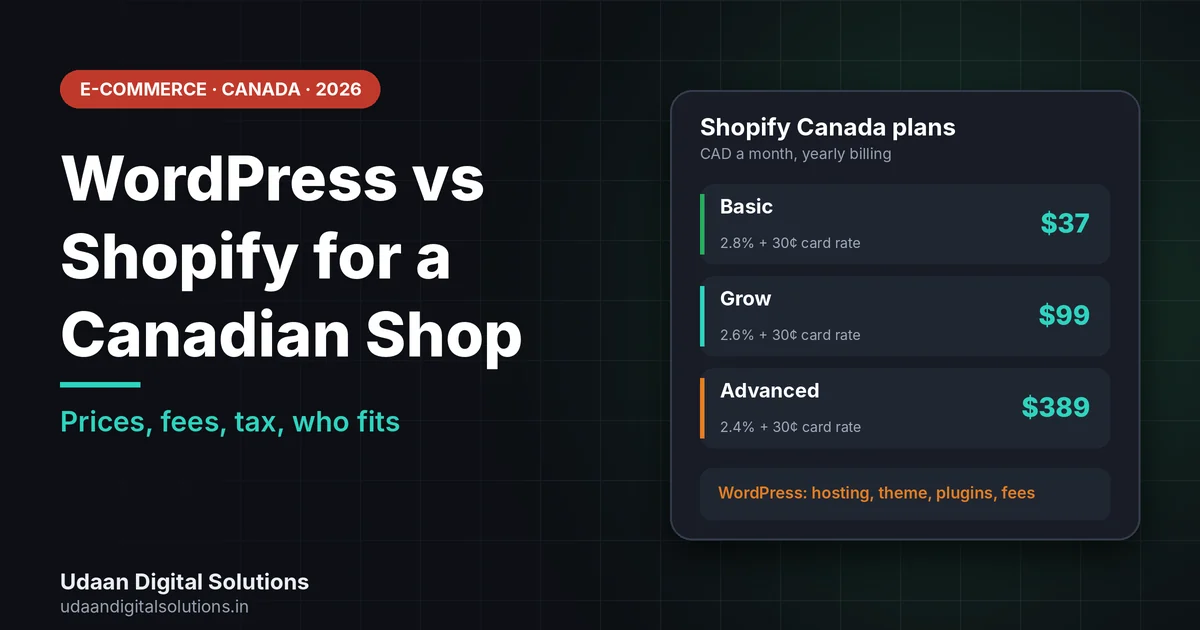
Shopify’s Canadian pricing page, read on 25 October 2026, listed the plans below. Its comparison table labels the amounts as CAD, while the plan cards show only a dollar sign. The page lists a short free trial, then $1 a month for three months, before standard pricing applies.
| Plan | Monthly price on yearly billing | Monthly price on monthly billing | Online card rate | Third-party gateway fee |
|---|---|---|---|---|
| Basic | $37 | $49 | 2.8% + 30¢ | 2% |
| Grow | $99 | $132 | 2.6% + 30¢ | 1% |
| Advanced | $389 | $517 | 2.4% + 30¢ | 0.6% |
| Plus | Not shown | From $3,400 | 2.15% + 30¢ | 0.2% |
Fees matter in WordPress vs Shopify, and an example shows how they add up. Suppose a Basic-plan shop takes $10,000 in online card sales across 200 orders in a month. At 2.8% plus 30 cents per order, card fees would be $280 plus $60, or $340. That is on top of the plan price, and any apps. If you instead use a third-party gateway, the page lists an extra 2% fee on Basic, plus whatever that gateway charges. This is an illustration, not a quote.

WordPress vs Shopify side by side
This table compares the two in general terms. Project details change the picture, so use it as a starting point.
| Area | Shopify | WordPress with WooCommerce |
|---|---|---|
| Hosting | Included; Shopify runs it | You choose and pay for hosting |
| Setup effort | Lower; store features are built in | Higher; you assemble theme, plugins and payments |
| Cost shape | Monthly plan plus payment and app fees | Hosting, theme, extensions and developer time |
| Control and flexibility | Within Shopify’s system and apps | Very high; you control the code and data |
| Content and blogging | Basic blogging built in | Strong; WordPress started as a publishing tool |
| Updates and security | Handled by the platform for the core system | You or your developer update core, theme and plugins |
| Sales tax | Tools to charge tax; you file and remit | Plugins or settings; you file and remit |
| Best for | Shops that want to launch quickly | Content-led shops, custom needs, or an existing WordPress site |
Which fits your Canadian shop?
Find the row that looks most like your shop in the WordPress vs Shopify debate. If two rows fit, pick the platform that lowers your biggest risk, whether that is time, cost or control.
| Your situation | Usually fits | Why |
|---|---|---|
| A first-time shop owner with a small catalogue and little time | Shopify | Hosted, simpler, fewer parts to manage |
| A shop whose traffic comes from articles, guides and SEO | WordPress with WooCommerce | Strong content tools and control |
| A business that already has a WordPress site | WordPress with WooCommerce | Add a store to the site you have |
| A shop that needs unusual features or deep custom logic | WordPress or custom | More control, but more build cost |
| A fast-growing store with high order volume | Compare both in detail | Fees, apps and developer cost all change at scale |
5 steps to choose between WordPress and Shopify
List your products and how you sell
Before comparing WordPress vs Shopify, count products, variants and how many orders you expect. Note whether you sell shipping, digital goods, bookings or subscriptions. This decides which platform needs fewer workarounds.
Add up the real monthly cost of WordPress vs Shopify
For Shopify, add the plan, the card rate and any third-party gateway fee, plus apps. For WordPress, add hosting, domain, theme, extensions, payments and maintenance. Compare totals, not headlines.
Check Canadian tax and shipping needs
Work out where you must charge tax and how you ship. Shopify says it does not file or remit tax for you, and the same applies to any platform. Ask an accountant before launch.
Want a second opinion on your store platform?
Udaan Digital Solutions can review your product list and budget and suggest WordPress or another route honestly. Our e-commerce website plans start at ₹25,000 in Indian rupees; ask for a quote in your currency.
Talk to Our Team See Pricing →Pick who will maintain it
A hosted platform reduces maintenance. WordPress gives control but needs updates and backups. Decide whether you or a developer will do this, and what it costs.
Test WordPress vs Shopify before you commit
Shopify’s page lists a short trial. For WordPress, build a staging copy with a few products and place test orders. Test checkout on a phone.
Canadian tax and messaging rules to remember
Sales tax. Shopify’s help page says it helps simplify charging sales tax but does not remit or file taxes for you, and that you must check with the Canadian and provincial tax agencies or a tax professional. It also says some Canadian tax options depend on when a store was set up. The duty to charge, file and remit rests with the merchant on any platform.
Marketing messages. Canada has an anti-spam law, known as CASL, that applies to individuals, businesses and organisations sending commercial electronic messages. Get consent, identify your business and give a working way to unsubscribe, and confirm the details with the government’s guidance or an adviser before emailing or texting customers.
Working with a WordPress developer in India
If WordPress wins the WordPress vs Shopify decision and you hire an agency in India to build the store, agree meeting times early. The gap changes when daylight saving ends on 1 November 2026, and India does not use daylight saving.
| Where | Time zone | Gap with India |
|---|---|---|
| Toronto, Montreal, Ottawa | EDT, UTC-4 until 1 November 2026; EST, UTC-5 after | 9 hours 30 minutes behind India until 1 Nov; 10 hours 30 after |
| Vancouver | PDT, UTC-7 until 1 November 2026; PST, UTC-8 after | 12 hours 30 minutes behind until 1 Nov; 13 hours 30 after |
Because of this gap, many teams plan calls in your morning, which is the agency’s evening, and use written updates in between. For more on SEO outsourcing to India, read our guide to SEO outsourcing to India for US small businesses. Before you choose any platform, check your site’s speed, as our guide to Core Web Vitals on WordPress explains. If your shop is an Indian business instead, see WordPress vs custom website for a small business in India.
WordPress vs Shopify checklist
Tick each line before you pay for any platform.
- Catalogue: Products, variants and expected orders are written down.
- Total cost: Twelve-month cost estimated for both options.
- Fees: Card rate and any third-party gateway fee checked on the current page.
- Tax: An accountant has confirmed how you charge and file tax.
- Ownership: You hold your domain, product data and customer list.
- Maintenance: A named person handles updates and backups.
- Testing: Test orders placed on a phone.
- Exit: You can export products and redirect URLs if you move.
Frequently asked questions: WordPress vs Shopify
Is Shopify or WordPress better for a small shop in Canada?
Shopify suits a shop that wants a hosted store running quickly with less technical work. WordPress with WooCommerce suits a business that wants full control, a content-heavy site or lower platform fees, and can manage hosting and updates. Neither is best for everyone, so match the choice to your time, skills and products.
How much does Shopify cost in Canada?
On 25 October 2026, Shopify's Canadian pricing page listed Basic at $37 a month on yearly billing and $49 on monthly billing, Grow at $99 and $132, and Advanced at $389 and $517, with Plus from $3,400. The comparison table labels these as CAD. Check the page for current prices.
Does Shopify charge extra transaction fees?
Its payment processing has a card rate, which was 2.8% plus 30 cents on the Basic plan online. The page also lists a fee of 2% on Basic for orders using a third-party payment gateway. Rates fall on higher plans. Confirm the rates for your plan before you launch.
Is WordPress free for an online store?
The WordPress software is free, but a store still costs money. You pay for hosting, a domain, a theme, extensions, payment processing fees, backups and someone to maintain it. Add those up before comparing against Shopify's monthly price, because the total matters more than the licence.
Who handles sales tax in Canada on each platform?
You do. Shopify's help page says it helps simplify charging sales tax but does not remit or file taxes for you, and you must check with the Canadian and provincial tax agencies or a tax professional. WordPress tax plugins work the same way, so ask an accountant.
Can I switch from Shopify to WordPress later, or the reverse?
Yes, but plan it. You can export products and customers on most platforms, but designs, apps and some data may need rebuilding, and URLs should be redirected to protect search visibility. Keep your own copies of images, product data and customer records from day one.
Related reading and sources
- WordPress vs Custom Website for a Small Business in India
- SEO Outsourcing to India for US Small Businesses
- Improve Core Web Vitals on WordPress
- Shopify Canada pricing
- Shopify Help Centre: taxes in Canada
- Government of Canada: Canada’s anti-spam legislation
- W3Techs: WordPress usage statistics
Final verdict
In the WordPress vs Shopify choice, Shopify usually wins on speed to launch and WordPress on control and content. Add up twelve months of real cost, including card fees, apps, hosting and maintenance, confirm Canadian tax duties with an accountant, and test both before you commit. Udaan Digital Solutions, Greater Noida, can help: +91 7042278448.
Compare your options with us
Send your product list and budget, and we will outline a WordPress route and what it would cost.
Contact Udaan Digital Solutions © 2026 Udaan Digital Solutions · Greater Noida, Uttar Pradesh, India · udaandigitalsolutions.in
Shopify, W3Techs and government pages were read on 25 October 2026 and can change. Shopify prices are as shown on its Canadian page, and the fee example is an illustration. Udaan Digital Solutions is not affiliated with Shopify or WordPress. This article is not tax or legal advice.